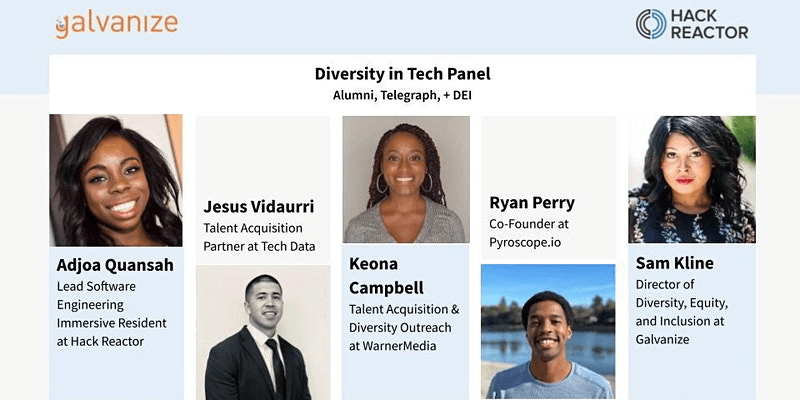
I love conferences. It’s something I miss from my days studying anthropology in college. I like the idea of a bunch of people getting together for the purpose of learning something. Covid19 has been tough on social gatherings of all kinds, but I have had the chance to attend a few meetups, such as hearing my favorite authors talk about their books, or, in the case of this week, a panel discussion on diversity in tech. It was organized by Galvanize, and the panel featured a diverse lineup of presenters.
I’m a big fan of diversity in the workplace. It seems dumb to say so explicitly; who would say they don’t? However, some things should be said out loud, and talked about. Employing people with varied backgrounds and experiences can benefit an organization in situations as small as break room conversations, to identifying major problems before they happen.
Diversity is not without its challenges though. Conflict happens in any workplace. In order to resolve it, people must have uncomfortable conversations. They must be willing to see what they did wrong, accept it, and change their behavior. If someone feels uncomfortable, they have to be willing to speak up about it.
The discussion was interesting, and the panelists shared their thoughts on a variety of topics. It was loosely structured so that audience members could ask questions, and the moderator would select a question to ask the panel. The speakers were gracious, and shared their experiences in the field, some good, some uncomfortable. I’ve included some highlights from the talk below.
Q: Why does everybody have to have a seat at the table?
Jesus Vidaurri: A Police Department was trying to implement machine learning and data science into profiling. When you have other people at the table, they look at it in different ways, and they might say “hey, how does this affect black and brown communities?”
Adjoa Quansah: It’s important to see products that address different needs. There are various products that people from different communities need, use, and develop.
Keona Campbell: If you want to scale and grow, it’s important to have input from your consumers, employees, interns, and global, diverse input to grow your business and consumer base
Q: When have you faced adversity?
Adjoa Quansah: Looking at a bootcamp, [an assistant] who was a white man said “people applied, women, people of color, for those people the bar is lower, and because of that they don’t do as well.” Are people going to look at me as ‘oh, you only got in here because you’re a woman’, it’s imposter syndrome, but it helps to remember that there are a lot of people of different skills and backgrounds, and that perspective helps, and that you’re not just there to meet a quota.
Sam Kline, following up on Adjoa: Just because we are diverse doesn’t mean we’re lowering the bar.
Ryan Perry: Terminology like master/slave in hardware, and when co-workers anthropomorphize master/slave servers as though they’re people; at the time, I didn’t really know how to handle it. At the time, it was less common for people to speak up about it, but now it’s a lot more well-known, and you start to see these kinds of things change, such as GitHub using the term ‘main’. If you’re at a company that’s worth being at, people will change.
Jesus Vidaurri: The person who came up with those terms was not thinking in terms of African slaves, but had someone from one of those communities been in the room, they probably would have had some suggestions.
Q: What are some examples of bias in the workplace? What can you do about it?
Keona Campbell: Getting referrals from college buddies, etc. People saying “oh! They’re so articulate” but only about people of color. It’s important to ask clarifying questions like “what do you mean by that?” Finding a mentor is important, for venting, and networking. At the final stage of interviewing, you can ask “if I experience bias in the workplace, what is my path forward?”.
Jesus Vidaurri: If you hear some form of bias, or see something going on, you have to speak up. The person might not know, it might be ignorance and they just have to be educated. Be an advocate for others.
Q: What are some tips for getting hired?
Jesus Vidaurri: You might have to accept a desk role, or something that isn’t in development, and that can put you in a place to transition into a job, because you have a background in development. 2) You can negotiate. If I interview for a company, I’m going to ask what I think I’m worth. Do your research, understand the market, and know what your worth is. The worst thing they can do is tell you no.
Ryan Perry: I wish I’d known that when it rains, it pours. He applied to many jobs, and eventually was offered a bunch of jobs.
Q: What is some advice for allies?
Jesus Vidaurri: True allyship starts with practice. Go to rallies, you have to go out and practice it.
Ryan Perry: Don’t be defensive, acknowledge when you mess up, and make it an environment where people can tell you. Don’t be afraid to say “my bad”. It is frustrating and hard to confront people, and people can say stuff without even thinking or meaning anything bad. Work to make it a comfortable environment for people from different backgrounds.
Keona Campbell: See how people are feeling, and if humor works, that’s a way you can stand up as allies, and anonymously report situations to HR.
For more information on this event, and for upcoming events, click the link below! https://www.galvanize.com/events
 Corbett Winningham