Last year I set a goal of reading 50 books. That works out to about one per week. I am happy to report that I met that goal, and have set a similar one for this year! Something I didn’t realize before starting that project was that when you do that amount of reading, you actually have to search out and acquire reading material, either for free at libraries, or actually pay for them from bookstores. Anyway, among the books and other media I consumed last year, these were four of my favorites that had to do with hacking and computer science. I hope you enjoy these as much as I did!
Zer0es, by Chuck Wendig
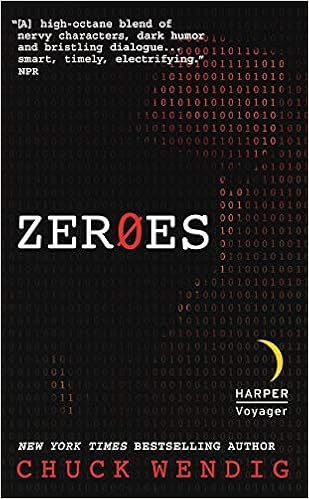
“An Anonymous-style rabble rouser, an Arab spring hactivist, a black-hat hacker, an old-school cipherpunk, and an online troll are each offered a choice: go to prison or help protect the United States, putting their brains and skills to work for the government for one year.” That’s the premise of this book by Chuck Wendig, and it’s just the start of a rip-roaring adventure story that blurs the line between cyberpunk, body horror, and heist. In particular, I love the way Wendig highlights the various kinds of hackers that show up in this story.
The Millennium Series, by Larsson and Lagercrantz

“…a crusading journalist and a cyberpunk hacker team up to drag Sweden’s darkest secrets into the light: family scandals, political corruption, sex crimes, and murder.” I’m not sure I’d consider Lisbeth Salander to be a cyberpunk, but she’s definitely a punk hacker. If you don’t recognize the title, you still probably know the first book in the series as The Girl With the Dragon Tattoo. The first three books were written by Larsson, but were only published after he died, at which point Lagercrantz officially took over writing the series. I love murder mysteries, and these books definitely qualify. While Salander’s hacking skills feature prominently in the first three, the fourth book is where the author’s attention to detail stands out. It’s rare that you find a book that takes the time to explain the Rivest–Shamir–Adleman cryptosystem.
Motherhacker, by Gimlet Media

“Bridget’s life is a series of dropped calls. With a gift for gab, an ex-husband in rehab, and down to her last dollar, Bridget’s life takes a desperate turn when she starts vishing over the phone for a shady identity theft ring in order to support her family.” Okay, so this is one wild podcast. It’s scripted, it’s got a surprising number of famous voices in it, and it’s very well done. Motherhacker is like a found-footage radioplay. The story is told as if the audience is listening in on ambient devices, like smartphones and home AI systems. This is not a story about computers, it’s a story told through computers, about the people who need them to survive. This is the perfect story for when you feel trapped by the dystopian nightmare that is the gig economy.
Phreaks, by Matthew Derby

“…when a fateful call connects her to a mysterious band of proto-hackers calling themselves “Phone Phreaks,” the revolution comes home, changing Emma’s life for good. Because Bell Telephone, the world’s biggest corporation, is not amused that a handful of teenagers suddenly have the power to seize control of its vast and lucrative network and bend it to their will.” This is a retro story all about the origins of hacking! It’s got cults! It’s got conspiracies! It’s got powerful corporate bad guys (plural)! Having spent the last year in lockdown makes this story about a blind girl who prank-calls random strangers all the more relatable.
Countdown to Zero Day, by Kim Zetter

“A top cybersecurity journalist tells the story behind the virus that sabotaged Iran’s nuclear efforts and shows how its existence has ushered in a new age of warfare—one in which a digital attack can have the same destructive capability as a megaton bomb.” This is the only non-fiction I’ve included on this list, and it’s because it was that good. Kim Zetter expertly unravels this truly bonkers story of international espionage. My favorite part is the chapter where Zetter describes the history and vulnerabilities of industrial machinery, where researchers were given a generator to experiment on, and everyone looked on in horror as some software told the machine to rip itself apart. Maybe this stands out because I listened to it on audiobook while I was driving across Roosevelt Dam, and then through Miami-Globe, AZ, in the shadow of all the industrial mining equipment.
Well, there you have it! My favorite hacker stories from 2020. Some are funny, all of them are exciting, and great if you want to get into hacker literature. All of these are available in audio format, which I love. I recommend you check them out!
 Corbett Winningham